Showing posts with label Race outside the United States. Show all posts

Sunday, March 23, 2014

Arab-Asian singer tops the charts in France

This is my English translation of this French article, which was written in January. This month her debut album was the #1-selling album in France in its first week of release. 


Indila: This Winter's Surprise Hit
by Eric Bureau

She's everywhere. Hard to turn on the radio without hearing Indila, impossible to watch a music channel without seeing her video for "Dernière Danse" ("Last Dance") in Paris. First solo song and first hit. Number 2 bestselling single behind Pharrell Williams' "Happy", number 1 music video on TV, in addition to 35 million Internet views (as of March 2014).

Even without an album, she still landed her first TV performance on the acclaimed show, Vivement Dimanche ("Can't Wait For Sunday"), invited by an artist who found her song irresistible.

She's everywhere…and nowhere. Elusive. When you do an Internet search for Indila, you'll find virtually no information on her, neither official nor personal. Instead, her collaborations with popular rappers, and the release date of her debut album, February 24. Different websites say she's of Algerian descent, between 26 and 33 years old.

When we meet her in Paris, at Davout studio where she recorded her album with her "musical partner in crime", producer Skalp, she brilliantly sidesteps and eludes questions. "I'm the same age as my music, which is timeless. How old you think I am?" Between 25 and 30. "Okay then I'm between 25 and 30 today," she laughs. "Then we'll see tomorrow." Equally mysterious, her life story. "I'm a true Parisian, born in Paris. A child of the world. My family's heritage is Algerian, but also Cambodian, Egyptian, and Indian. And might I add: my middle name, Indila, comes from my endless love for India."

She ends up revealing that she was a tour guide at Rungis Market, the world's largest wholesale food market. She's always loved singing but hasn't formally studied music. In her formative years, she was raised on a diet of Enrico Macias, Michael Jackson, Brel, Edith Piaf, Algerian singers like Warda and Indian ones like Lata Mangeshkar. "Music is like me. No borders or barriers," Indila says in a soft voice, almost childlike, but self-confident. "It's no trouble for me at all to switch from Hip-Hop to adult contemporary."

Her album makes it clear she hasn't always seen the bright side of life. Her song "Last Dance" contains a play on words with "douce souffrances" ("sweet sufferings") and "Douce France" ("sweet France") by Charles Tenet, which she used to sing as a child with her older sister while bicycling. In "Tourner dans le vide" ("persevering amidst emptiness"), her next single, she laments the absence of a loved one, dark-skinned, son of a laborer, and hopes for his return. "Yes, this album talks a lot about the absence of loved ones and the void that it leaves, about memories, but about hopes too, about life passing by too quickly."

Pokerfaced, holding a cup of tea, she also drops this incredible statement: "I'm being born with this album, I didn't exist before. What matters isn't my life, but the story I want to tell the public."

Keeping things simple. For the sake of style? "I don't like to talk much. Even less so about myself," she tells us. "So far, I've been satisfied being in the shadows of the rappers I sing with, that's given me a sense of security." With the success that awaits her, she's going to have to force herself into the spotlight.

Thursday, May 16, 2013

Idol Winners of Mixed Heritage

Tonight, American Idol will crown a new winner. More than 40 countries have their own version of the competition.

Below are winners of Idol TV shows around the world. Each of them are of mixed-race descent and/or upbringing, a reminder that music exists in every culture.


Guy Sebastian - Australian Idol, 2003
White (Portuguese and English) and Sri Lankan


Taufik Batisah - Singapore Idol, 2004
Indian and Indonesian


Ben Lummis - NZ Idol, 2004
White (New Zealander), Maori, and Tongan


Melissa O'Neil - Canadian Idol, 2005
White (Canadian) and Chinese


Jorun Stiansen - Idol (Norway), 2005
Transracial adoptee: Colombian raised by Norwegian (White) parents


Eva Avila - Canadian Idol, 2006
White (French Canadian) and Peruvian


Mau Marcelo - Philippine Idol, 2006
Puerto Rican (White and Black) and Filipino


Matthew Saunoa - NZ Idol, 2006
White (English) and Samoan


Jordin Sparks - American Idol, 2007
Black (American) and White (American)


Mark Medlock - Deutschland sucht den Superstar (Germany), 2007
Black (American) and White (German)


Diandra Flores - Idols (Finland), 2012
White (Finnish) and Chilean


Sophie-Tith Charvet - Nouvelle Star (France), 2013
White (French) and Laotian


Thursday, December 01, 2011

French colonial Vietnamese-Africans

This is my English translation of this French article.


War and Race Mixing: "I was born from a Vietnamese mother and a Senegalese father."
by Florence Lame


The bloody war in Indochina caused more than 500,000 deaths, 15,000 of which were African servicemen. The surviving servicemen fled Vietnam along with their women and children. What followed was a melting pot lineage, which today still retains the features of a love that transcended time and war.

The war began in the 1940s, following the Japanese invasion of Lang Son, a border town between Vietnam and China. It was the beginning of what's commonly called the "Indochina War", referring to a large peninsula which at the time consisted of Laos, Thailand, Cambodia, Burma, a part of Malaysia, and Vietnam. Seeing their sovereignty (dating from colonialism) threatened by Japanese attacks, the French army decided to call in servicemen from Africa as reinforcements for the army already there, they were the "Senegalese colonial infantrymen". With nationalist movements following WWII in 1945, the fighting lasted until 1954. At the end of this war, the servicemen who survived left Vietnam by boat, with some of them bringing along women and children: "My father took us all in his arms and we crossed the Pacific Ocean for months in boats that were constantly in danger of capsizing", recalls Jean Nguyen, son of a Vietnamese mother and Senegalese father. For most Vietnamese, Chinese, and Laotian women who had affairs with African servicemen, such escape was the only hope of surviving a massacre. Thus appeared in Africa a melting pot lineage: Senegalese-Vietnamese, Ivorian-Vietnamese, Morroccan-Vietnamese, etc.

Since their arrival in Senegal, very few Asian women returned to their homeland. Some lost everything and saw no reason to come back, others simply couldn't afford it. Today they're largely recognized and respected for having protected their families during the war, and having adapted to a world and customs that were previously completely unknown to them. They perfectly mastered the language, the cuisine, and the customs of their host country. But the integration of children from these unions was no easy task. "At first, our relationship with the Senegalese population was somewhat difficult. In the street, at school, we got called 'chinks'. There were many fights in the schoolyard because of that!" recalls Jean. But the Viet-Senegalese who live in Senegal today are considered to be Senegalese themselves.


Vietnam is known for being very conservative and it's sometimes hard for mixed-race people to make a life for themselves there. Nicole Hoang, a young woman of Senegalese and Vietnamese descent who speaks Vietnamese fluently, tells us about one of her visits to Vietnam: "It's harder for 'Black' mixed people. When they saw me speaking Vietnamese, having never seen Blacks, they couldn't fathom it. Yet the people who fought in the Indochina War were much nicer!" This racial mixing is for some an openness to the world, a rich culture, while for others it's the opposite: it's a disgrace. "I am the symbol high treason with the enemy, of a forbidden collaboration," confided Kim Lefèbvre, a Eurasian who grew up in Vietnam, in an interview for Eurasie.net.

Over time, most children of this generation migrated all over the world. Some have chosen to come settle in France, where notably they set up an organization for mixed-race Senegalese-Vietnamese people, The Lai-Den ("mixed race" in Vietnamese) in Paris. The same thing exists in the United States, such as the father of famous golfer Tiger Woods, for example, who fought in the Vietnam War, during which he married a Thai woman. This racial mixing, which was seen before as something incomprehensible, has thus become a distinguishing trait of African/Asian mixed people, but most of all, an identity in it's own right.


Tuesday, September 11, 2007

The world was America

Today is the 6th anniversary of the September 11, 2001 attacks. Most people consider it to be an American tragedy just because it happened in the US. But the fact is, dozens of nations lost citizens in the attacks. It happened in America, but not everyone who died was an American citizen.

According to this page from the United Arab Emirates' American embassy, the victims of 9/11 came from 82 countries; including 25 people from Canada, 67 from Britain, 16 from Jamaica, and 15 people each from the Philippines and Mexico.

When most people think of Americans, they think of White people who speak English. But the people who died in 9/11--an event that happened in America--are so much more diverse than that. They came from more than 80 countries in 6 continents. The French newspaper Le Monde said it best with their September 13, 2001 headline: "Nous sommes tous Americains" ("We are all Americans"). It seems like the only thing that's really "American" about 9/11 is its location. If we're talking about the deaths and the loss of human life, 9/11 was more global than anything.

And even if we do consider only the American citizens who died, we still get a racially mixed group of people; most of the victims were from New York City, which is one of the most ethnically diverse cities in the world.


`

Sunday, August 12, 2007

First White child

In Australia, the first baby with European ancestry was born on January 26, 1788. In the US, the first was in the 1560s, and in Canada, it was probably in the early 18th century. During colonial times, people in European colonies would often celebrate the birth of the "first White child" in their settlements. There was once an American postage stamp that celebrated the first European baby in North Carolina, USA (picture above).

When I learned about this, my first reaction was "that's racist!" If anyone celebrated something like that today, it would be the Ku Klux Klan or Neo-Nazis. And then I thought, "is it really racist?"

Celebrating White/Caucasian ethnic heritage is a lot more controversial these days because many people will think it's White supremacy or racism. A really good example of this is when Lisa McClelland (picture at left), a high school girl in California, tried to start a "Caucasian Club" 4 years ago, and it became a national controversy.

There's nothing wrong with being proud of your White/European heritage, but Whites/Europeans have been overrepresented throughout history and Eurocentrism has historically been a "normal" thing, so people might misunderstand you. Non-European heritages should definitely be celebrated because they've always been ignored, but celebrating Asian, Black, Latino, and indigenous cultures should never mean looking down upon European heritages. That's what Whites/Europeans have done to other people throughout history, and doing that to them would just reverse the hatred, when there should be no hatred in the first place.


`

Sunday, August 05, 2007

More than Indian or Chinese

On July 22, 2005, police in London, England mistakenly killed a man because they thought he was a terrorist. People said the guy had an "Asian" appearance. On June 30, 2007, there was an attack at Glasgow International Airport in Scotland, and the suspects were also described as "Asian."

But wait.

Did they mean these guys looked Chinese? In America, if someone looks "Asian" it means they look "Chinese" (regardless of what ethnicity they actually are). But these events happened in the United Kingdom; when they said "Asian" they meant Indian (from India). The American media would never use the word "Asian" to describe people from India (maybe they would use the term "South Asian").

Most people will agree Filipinos are Asian, but I have never heard people use "Asian" to describe their appearances. In the US, Asian is generalized as Chinese. In the UK, Asian is generalised as Indian. In the Philippines there are people who look Chinese, Indian, or a mix of both, like boxer Manny Pacquiao (picture above).

"Asian" usually refers to Chinese or Indian, but it doesn't always mean people from China and India.

In the United States, "Asian" usually means people from here:


...Vietnamese, Japanese, and Koreans are generalized as "Chinese."

But in the UK, "Asian" is:


...Pakistan, Sri Lanka, and Bangladesh are also included.

I don't know what "Asian" means in Australia/NZ or Canada. If you are from those countries, please comment.

In any case, "Asian" more accurately means people from here:


`

Monday, January 01, 2007

New Year Special: interracial history

It's 2007! And to ring in the new year, I thought I'd take a look back at mixed-race experiences of the past. We often think about interracial marriages as being a new thing, but it's been around for centuries. Here are some random multi-ethnic stories from the past.


During the 1950s, North Korea and East Germany had a foreign exchange program which allowed Korean students to study at German universities. This resulted in some interracial marriages between German and Korean college students. However, it also resulted in some heartbreak; in 1961, North Korea ordered their students to return home. Some of the German wives have been trying to reunite with their Koreans husbands for more than 40 years.

Separated by fiat, a German awaits North Korean spouse

Please Find My Husband… Heartbreak over a Repatriated Husband


One can only imagine what half-Japanese people experienced during World War II; especially if the other half of their heritage was a country that was fighting Japan. Here is an article (with an audio interview) about 2 orphan sisters who grew up in Britain during the 1940s. They did not know until they were older that their mother was British and their father was Japanese.

Home Truths: Half Japanese


In 1889, a Chinese immigrant to the U.S. named Huie Kin married a Dutch American woman named Louise Van Arnam. Today, the descendants of their 9 children comprise a multi-ethnic clan who are proud of their mixed heritage (mostly European and Asian), which is celebrated at their family reunions.

The Huie Kin Family's Dynasty of Diversity


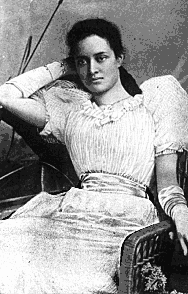
Victoria Ka'iulani would have been the next queen of Hawai'i, had the monarchy not been overthrown in 1893. She was the daughter of a businessman from Scotland and a princess in Hawaii's royal family, which made her half Hawaiian and half Scottish.

Women in History of Scots Descent: Princess Kaiulani

Sheraton Princess Kaiulani: History of the Princess


`

Monday, December 25, 2006

The Face of Tomorrow

As we enter a new year, many of us must be wondering what the future will be like. As someone who has a habit of viewing things through a racial lens, I'm wondering about the possible ethnicities people might have in the future--and what these people might look like. With anti-miscegenation laws broken down and continuing immigration (not just in America, but around the world), mixed-race people are becoming more common and the world is beginning to see human faces that almost didn't exist a century ago. But what will happen a century from now?

Today, there are an increasing number of people who are half one ethnicity, and half another ethnicity; if you go to places like Hawaii, you'll encounter people whose ancestry is even more complicated (and you can usually tell by the way they look). If you ask a young person what his or her ethnicity is, don't always expect a one-word answer.

So without getting into genetics or biology, what will people look like in the 22nd or 23rd century? We can almost be certain that they won't look like anyone who has ever lived. Faces of the future will embody the mixing of races that is continually becoming more common today. They probably won't look like any ethnic appearance that has ever existed. This has happened before. Many Latino/Hispanic people are generations and generations of mixed Native American and Spanish ancestry, and as a result, many of them look multiracial (on a related note, people who are half-Asian and half-European are commonly mistaken to be Mexican). Do you think there were people who looked like modern-day Latinos before the Spanish arrived there?

The mixed-looking appearance of many Latino people is a result of colonial mixing hundreds of years ago, and we have to wonder: what kind of facial features will today's racial mixing bring about hundreds of years from now? In today's multiracial people, we can see the faces of tomorrow. But a photographer named Mike Mike is taking a different approach.

The curiously-named Mike Mike is from Istanbul, a city that's historically considered to be in both Europe and Asia, and sure enough, many of the residents there look mixed-race. This is probably what inspired him to do a photography project called The Face of Tomorrow.

Mike is going to several cities around the world, and in each city, he takes pictures of 100 random people, and then combines all of them (using computer graphics) to make 2 faces: one male, and one female. The idea is that these 2 faces will be what a person in each city will look like a century from now, and that a city's population represents its racial (and facial) future. From the website:

"The large metropolises of the world are magnets for migrants from all parts of the planet resulting in new mixtures of peoples. What might a typical inhabitant of this new metropolis look like in one or two hundred years if they were to become more integrated? [...] if you could combine all the faces in a city right now you would be looking at the future face of that city."

Here are a few faces that've been done already:

Rio de Janeiro

Hong Kong

London

Sydney

The Sydney face was done with people at Sydney University, so not surprisingly, it looks more mixed-race than the others (in my opinion) since colleges tend to be diverse. The London face, which looks very European, surprised me because my brother went there and he tells me it's very diverse. (Mike explains on the website that the London face isn't very accurate because the photos he took for it happened to be in a very White part of the city).

The Hong Kong and Rio de Janeiro faces, as well as most of the other ones done so far, look more like a general appearance of a modern-day resident in each city, instead of a future mixed-race person, because a lot of those cities aren't really melting pots or salad bowls. But what if The Face of Tomorrow was done in North American cities? I would love to see what this project yields in super-diverse places like New York, Toronto, or San Francisco; those cities are just begging to be included (or at least, I'm begging that they be included).

It's probably impossible to know for sure what people's faces will look like hundreds of years from now. With the mixing of so many ethnicities, it's possible that everyone will eventually look like the same race--the human race. With a new year upon us, we're one step closer to seeing these faces...whatever they will look like.


`

Monday, December 18, 2006

"Kim" isn't always Korean

By now you've probably heard about a family that was stranded in the snow in Oregon earlier this month. When James Kim, his wife, and their daughters went missing a few weeks ago, the story made international news, probably because Kim was well-known within the technology community; he was an editor for CNET and also worked for TechTV.

When I noticed that this story made news around the world, I couldn't help but wonder about what people thought about James Kim's ethnicity. I've never seen news reports that mentioned he was Korean-American, and that's a good thing, because mentioning race would be inappropriate here. However, when people outside of America heard about this, they probably assumed it was a White family who were lost (because most Americans are White). If they saw James Kim's picture, they probably assumed it was an Asian family who were lost.

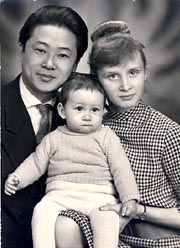
Actually, it wasn't a White OR an Asian family that was lost...it was both! No, there weren't two families, it was just one. You're probably confused right now--unless you're aware of miscegenation. James Kim was Korean (ethnically) but his wife was White. That's her in the picture above with one of their children. My point is, I'm glad the media didn't say anything about ethnicity when covering this story, but it disturbs me a little that some people would assume this family is full-Asian just because they saw James Kim's picture, or assume this family is full-White just from seeing his wife's picture.


`

Saturday, September 16, 2006

Racism from a non-racist attack

This week, there was a school shooting in Canada (Montreal) and the shooter was a 25-year-old Canadian man. Hold on...what image did you get when I said "Canadian man"? Did you imagine a White guy? Most likely you did, because many people assume "Canadian = White".

The Dawson College killer was Kimveer Gill, which is a name that could be interpreted as mixed-race because it sounds ethnically unclear. Shortly after the shooting, a witness was being interviewed and he was asked what race the shooter was. He shrugged and said "White"...he said it as if it didn't matter what race the killer was.

It turns out Gill's heritage is Indian (from India) and he was born in Canada. He posted some pictures of himself on the Internet (which have since been taken down), and he does look somewhat mixed-race. However, he is technically Asian (because India's in Asia), one witness said he was White, and on one of his photos, someone made a comment calling him a Middle Eastern terrorist.

So...a witness thought he was White, an angry person on the Internet thought he's Arabic, but in reality, he's Asian. The shooting is believed to be random violence, and not a racist or terrorist attack. Yet when people see what he looks like or learn what his ethnicity is, some of them immediately make racist comments. Some of them start thinking it WAS racist or terrorist, even when the attack itself wasn't.

All of this shows that people usually assume that individual humans can only belong to one race. The witness who said that he was White, was responding to a question of whether Gill was "White, Black, (or) Asian". White, Black, Asian? You mean there's no in-between? Of course there is! Now, let's say Kimveer Gill WAS mixed-race instead of only Indian. Let's say he was White, Black, AND Asian (yes, that's genetically possible). Would there still be racist comments towards him? There definitely would be, but what?


Monday, August 07, 2006

Jim Crow in Japan

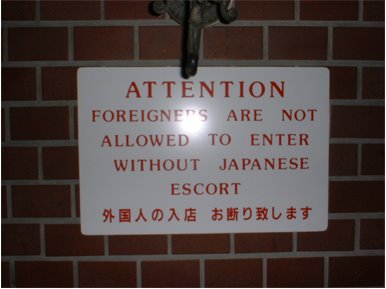
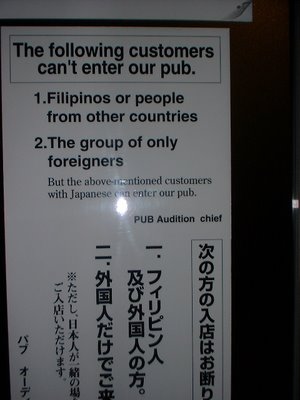
For a country where one ethnicity makes up over 99% of the population, it's understandable why racism isn't a such a big deal. But when I saw these signs, which are common in modern-day Japan, I couldn't help but feel shocked.


This kind of thing is accepted?! One of the most industrialized and developed countries in the world is actually fine with racial discrimination!? Don't they realize that there will ALWAYS be some sort of gray area about who is Japanese and who isn't? Not to mention, this kind of thing could damage foreign relations with other countries. And not everyone is going to be either 0% Japanese or 100% Japanese. Not only am I talking about mixed-race people, but also Japanese citizens who aren't ethnically Japanese.

The website where I got the pictures above from belongs to a Japanese citizen who isn't Japanese by blood. At one point, he tried entering a club that said "Japanese only," but they wouldn't let him in--even after he showed them his Japanese passport. Obviously, those "Japanese only" signs are referring to race and ethnicity rather than nationality.

It makes me wonder how they react to part-Japanese people. Most likely they would consider them to be non-Japanese.

Most people would agree that racism is outdated, but in no way is it gone. Even in the racially diverse United States, where Jim Crow laws for segregation no longer exist, ethnic bigotry lives on quietly among the few hate groups that still exist. Japan is an even more fertile ground for racism because it's not diverse. Even if Japan is one the most successful economies in the world, and one of the most advanced countries on Earth, its race relations are anything but successful and advanced.