Showing posts with label Segregation. Show all posts

Wednesday, November 23, 2011

French Native Americans

This is my English translation of this French article.


Those American Indians who speak French
by Jean-Michel Selva

Father Roch Naquin, Houma Catholic priest

The Houma tribe of Louisiana speak French the way it was used in the 18th century. But the destruction of their environment by oil companies threatens the harmony of this ethnolinguistic community.

They are the cousins of the Apaches and the Sioux. Their skin is red and they speak our language, or rather, that of Montesquieu. Houma Indians are the forgotten ones in the history of Louisiana, where they had to seek refuge from advancing white settlers from England in 1765, following the Expulsion of the Acadians. Already 30 km (18.6 mi) out from Houma, a little town south of New Orleans, and still nothing in sight except a narrow strip of land jutting out into the water. The huge 4x4 Chevrolet Silverado of Thomas Dardar Jr (below), community leader of the Houma Indians, speeds ahead of us and guides us across Isle de Jean Charles. Destroyed by Hurricane Katrina in 2005, the road, which sinks into the bayous towards the Gulf of Mexico, has just been rebuilt.

Finally, rising in the distance are Pointe-aux-Chenes and breathtaking houses on pilotis, a sort of mobile homes erected on wooden stilts, overlooking the lagoon. "Watch Pipeline", warn signs stuck in the middle of the waters, extending out from either side of the road. A few dead trees, eaten away by salt, are the only ones accompanying us on this road. In this abandoned setting live the majority of the French-speaking Houma Indians.

Black pants, turquoise shirt, and a vest with Indian designs on which his braid sways back and forth, stretching down his back, the leader Dardar stops between the pilotis under a huge yellow dwelling. Father Roch Naquin comes to welcome him, they greet each other with open arms, very French indeed.

Allies of the French

"At the end of the 17th century, before the strained relations between French and English settlers, our community naturally formed an alliance with the former, because the explorers Cavelier de La Salle and Pierre Le Moyne d’Iberville had always been supportive of it," explains Thomas Dardar. "As a result, our ancestors learned the French language, and passed it down to us orally. The vast majority of the Houma can neither read it nor write it, but they always speak it."

Banned from schools for being Indians, the Houma were eventually allowed to enroll in public education starting in 1964. But until 1975, they were punished whenever they dared to say a sentence in French. For this tribe of American Indians, a three-century-old form of French was able to endure, because of the cultural importance of oral tradition and their practice of it without contact with the outside world.


The Houma thus saved from oblivion expressions like: catin (harlot/whore/prostitute) for poupée (doll); char (chariot/tank/ wagon) for automobile (car); espérer (hoping) for attendre (waiting); s'épailler (removing dirt from badly forged gold) for s'étendre (stretching/spreading/expanding); and even "icitte" for "ici" (here), "au boutte" for "au bout" (at the end)...They mix as many words with Choctaw, their ancestors' language.

"The State of Louisiana granted us Indian nation status only in 1979," notes Thomas Dardar, "but we're still waiting for federal recognition, already rejected in 1994." "We here are the roughly 17,000 Houma Indians, divided into three clans, united by the use of the French tongue." Father Roch Naquin like to say he considers himself French and Indian. "My ancestor Charles came from the Bordeaux region and married an Indian. Here on Isle de Jean Charles, my father and those of his age spoke and wrote French. He then learned English, unlike my mother who never wanted to. Today only the eldest of my neighbors refuse to. The youngest became English speakers. It will be hard to preserve our language." At 55 years old, even the chief Thomas Dardar who's mastered French perfectly uses the American language more often. This generation of Houmas in their fifties may be the last to express themselves in the language of Molière. The last surviving link to a way of life that's already no more.

A Difficult Life

"Forests with tall trees used to grow here," recalls Chief Dardar. "Over there, my grandfather raised cattle in the meadows where muskrats would run," points Roch. "We had horses to plow the land, which produced enough to feed us. With the intensive oil drilling, salt water has leaked everywhere, it continues to eat our land and destroy all the vegetation."

To survive, the Houma community, scorned by everyone for centuries, turned to fishing. Some of them have managed to become lawyers and doctors, others have left to work in the shipyards. But for one year now, because of the oil spill in the Gulf of Mexico, the Houma can no longer fish like before. Skin diseases and respiratory problems have emerged. "They seem to be linked to BP spreading solvents to get rid of the oil slick floating in the gulf."

This fragile community is plagued and weakened even more: "very few among us have access to adequate social welfare," laments chief Dardar. "We've also suffered from the last four hurricanes. My house has been raised higher above ground on three occasions in twenty years, the roofing replaced a number of times. Leave and go elsewhere? No, no, this here is my house, this is the land of our ancestors," protests Father Roch Naquin.


Monday, October 01, 2007

Ethnic diversity has no language

For some reason, whenever I'm in a foreign language class, I usually never think about race or ethnicity. I'm the kind of person who thinks about those things ALL the time (as you can tell by this blog!). But when I'm studying another language, I completely ignore it. I don't know why.

For the past few months, I've been taking French classes, and I just realized, whenever I'm in those classes, I don't pay attention to the ethnicities of my classmates. Usually when I'm in a class, what I always notice is the different races in the classroom. But for some reason, I don't pay attention to that when I'm in a French class. When I'm in a French class, the ideas of race and ethnicity just disappear, and everyone around me becomes the same thing: an English speaker learning French. Not an Asian, Black, or White English speaker; not a mixed-race English speaker; but...a human English speaker. Ancestry and heritage become meaningless, and I feel this strange hippie-Utopian bond with my classmates.

I don't know why I stop thinking about race when learning French. But I don't think it has anything to do with that language. It could be any language. My brother had a similar experience when he was in Japan learning Japanese. He told me that the people in his class came from all over the world, and they were from many ethnicities. Then he said something like, "we're all connected by the Japanese language." Actually, I just found the e-mail he sent me two years ago. Here's exactly what he said:

Somewhat interesting with my school is that they try to avoid a skewed representation of various backgrounds so that people come from different countries and would use Japanese as a common tongue. So there's a mix of Asian, European, American and even some black folks.

Now I'm starting to think there would be no racism if everyone on Earth spoke the same language. But what that language would be, I have no idea.


`

Sunday, August 26, 2007

Single-parent heritage

Whenever people see a child with only one parent, they usually assume the kid is the same ethnicity as that parent. If there's a girl who is half Asian and half White, and people see her with her Asian father, most people will assume she's Asian. But if people see that same girl with only her White mother, they'll likely assume she's White.

As if it wasn't bad enough that people make these assumptions, the American government used to do this when collecting census data. Before the 2000 U.S. Census, mixed-race people in the United States could only choose one ethnicity. A woman named Susan Graham was filling out the Census in 1990, and she couldn't find a place on the form for her multiracial children. She asked the U.S. Census Bureau about it and they told her that mixed-race children are counted as the mother's ethnicity!

Graham is white. Her husband is black. When she received her 1990 census form, she complained to the census bureau that there was no place for her children. An official told her that children take the race of the mother because "in cases like these we always know who the mother is, but we don't know who the father is."

About the same time, her son was starting kindergarten. Her husbnd took him to school. [sic] A teacher, filling out a school form, concluded her son w
as black.

"We had the same child who was white on the census, black in school and multiracial at home," Graham said. "And I thought there's something wrong with this picture."


(Source)

Like she says, when the same person is White on the Census, Black in school, and mixed-race at home...there's something wrong.

This problem was fixed in the U.S. Census in 2000, but it still exists elsewhere. Many people still assume a person's mother and father are always the same ethnicity, and when they see someone who is biracial, they usually force them into one side. A well-known example of this is how the media usually refers to Tiger Woods as African-American. He's actually only 1/4 Black and is more Asian than any other race, but almost nobody calls him Asian-American.


`

Monday, January 22, 2007

Polite racist people

Last week was Martin Luther King Day and next week is Black History Month. We're in the middle of African-American celebrations and many African-Americans themselves are in the middle of being Black and non-Black (which I explained last week). This gray area of Black identity can sometimes lead to interestingly racist situations. Like this African-American woman who was served at a White-only diner:

KANSAS SIT-IN GETS ITS DUE AT LAST

Carol Parks-Haun was doing a sit-in protest against racial segregation at a diner in Kansas, when, to her surprise, she wasn't discriminated against:

Parks-Haun remembers entering (the diner). She sat down on the center stool and ordered a coke, but didn't think the waitress would actually serve her. [...] "She gave it to me and I said, 'oh my,' and the others came in and they sat and she looked at them -- and she looked at me -- and she leaned forward and she said, 'You are not colored are you dear?'"

"You are not colored are you dear?"? I never knew people could be polite and racist at the same time.

Of course, it's possible that the waitress wasn't prejudiced herself; she could've been just following orders. But I thought the whole point of prejudice was to prejudge people? Not ask them about themselves and then judge them. Can you see why it's weird to ask someone what race they are, just so you can say something racist? If you're going to discriminate someone, at least be confident about it. (Of course, it's better to not discriminate at all).


`

Monday, September 04, 2006

Mixed-race people won't "survive"

The new season of Survivor is going to divide the contestants by race. There's going to be 4 groups: White, Black, Hispanic, and Asian. Obviously this isn't very nice to people who belong to more than one race. They could have AT LEAST had one group of mixed-race individuals. What were they thinking?? People around the world are going to see this and then they'll think that mixed-race is impossible. And yes, there are people in the world--even in the United States--who have never heard of mixed-race.

Oh and what happens at the end of this season of Survivor? Whichever racial group wins, it's going to support some stereotype. If the White group wins, the Neo-Nazis, KKK, and all those supremacy groups will be all over it. If the Black group wins, people are going to talk about how they're good at athletics. Or if the Asian groups wins, someone might say something about the Japanese in World War II.

Whoever wins, their race will somehow be associated with their victory. And mixed-race people will be completely ignored.


Monday, August 07, 2006

Jim Crow in Japan

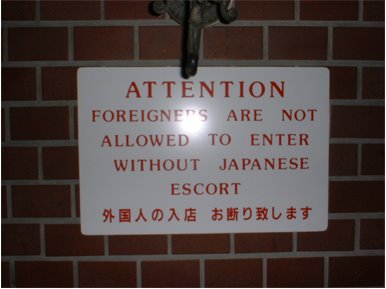
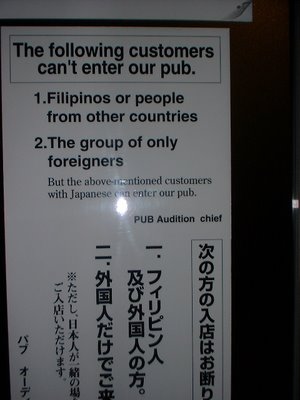
For a country where one ethnicity makes up over 99% of the population, it's understandable why racism isn't a such a big deal. But when I saw these signs, which are common in modern-day Japan, I couldn't help but feel shocked.


This kind of thing is accepted?! One of the most industrialized and developed countries in the world is actually fine with racial discrimination!? Don't they realize that there will ALWAYS be some sort of gray area about who is Japanese and who isn't? Not to mention, this kind of thing could damage foreign relations with other countries. And not everyone is going to be either 0% Japanese or 100% Japanese. Not only am I talking about mixed-race people, but also Japanese citizens who aren't ethnically Japanese.

The website where I got the pictures above from belongs to a Japanese citizen who isn't Japanese by blood. At one point, he tried entering a club that said "Japanese only," but they wouldn't let him in--even after he showed them his Japanese passport. Obviously, those "Japanese only" signs are referring to race and ethnicity rather than nationality.

It makes me wonder how they react to part-Japanese people. Most likely they would consider them to be non-Japanese.

Most people would agree that racism is outdated, but in no way is it gone. Even in the racially diverse United States, where Jim Crow laws for segregation no longer exist, ethnic bigotry lives on quietly among the few hate groups that still exist. Japan is an even more fertile ground for racism because it's not diverse. Even if Japan is one the most successful economies in the world, and one of the most advanced countries on Earth, its race relations are anything but successful and advanced.